
Monday, June 7, 2010
Wednesday, February 10, 2010

Wednesday, December 9, 2009

Friday, December 4, 2009

Monday, November 30, 2009
Monday, November 16, 2009
Tuesday, November 10, 2009
GREEN BUSINESS
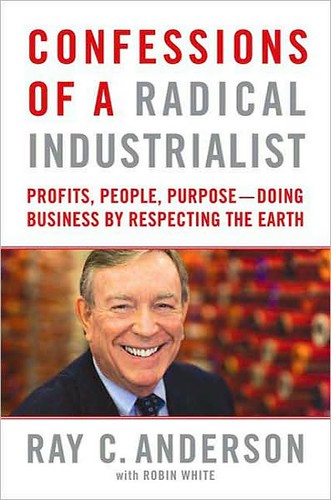
This is the new book by Ray C. Anderson. As you may or may not know, he owns a carpet company. But more importantly, he is one of the very first industrial leaders to take on his own impact on the environment, in recognition of the unsustainability of our current society. As a manufacturer, he is leading the way for environmentally sustainable industry.
This is one of the most important things that we need. This book is a follow-up to his first book, "Mid-course Correction: towards a sustainable enterprise." Of all the CEOs, how many are thinking like this?
Anderson worked for decades in his industry, which is extremely polluting and petroleum based, without a second thought for the environment. Then an employee sent him a copy of Paul Hawken's "Ecology of Commerce." Since then, he has been a pioneer; and that was in 1994.
He's a pioneer in the idea that while protecting the environment and being ecologically sustainable is incredibly important to the future of the planet, it is also just good business sense. Common sense, you might say. I remember I first heard of him when I saw "The Corporation", which is still a very pertinent documentary in my opinion. Most companies still aren't environmentally conscious or fair to their workers. Most set up overseas (known as 'outsourcing' or 'offshoring') to poor countries with corrupt governments, lax labour and environmental laws, and high fiscal debt. In fact, that's where most of our wealth comes from, and where most of our waste goes.
It's great to see him in at one part in 'The Corporation', when he's calling out a room full of the top CEOs in the States, for their unsustainable and irresponsible practices, calling them "plunderers," and referring to himself as a former plunderer. He makes a great analogy of the early 20th century, when people are trying to design a working flying machine. You know the footage. He describes our society as being like a totally non-working attempted airplane that can't possibly fly, going over a cliff. We're gonna crash.
In transforming his company, it was something that hadn't really been done before, so they had to try something new. Their were lots of surprises and happy accidents, and ultimately true innovations and an inspiring story of pioneering green business.
What's really important is the fact that environmental consciousness and sustainability is actually sound business and makes total financial sense. As John Kerry said, "It's a win-win for the marketplace." Most of Europe has already gone down that road, and they're way ahead of North America in terms of sustainability.
He calls his work "Mission Zero " - zero footprint, by 2020. Zero footprint is pretty damn ambitious.
Here's a clip of Ray Anderson. In it, when talking about reading "Ecology of Commerce," he mentions E. O. Wilson. Wilson is one of the world's top biologists, particularly entymology and microbiology. Anderson refers to him in reference to the current mass extinction going on in the world.
Spreading the idea of Green Business is important, because it's definitely the future. Otherwise, there will be no future.
Also here's a link to an interview with him: Sustainablog
Thursday, November 5, 2009
CLIMATE CHANGE
Last night I was browsing through the Montreal Mirror, when I looked at their 'Angels and Insects' segment. This really got me boiling:
"Insect >> Copenhagen gloom With a new Pew Research Centre poll showing a staggering decline in Americans’ belief in global warming and humanity’s role in it, there’s reason to doubt that December’s climate treaty talks in Denmark will accomplish anything meaningful. The poll revealed that only 57 per cent of respondents believed there is evidence the Earth’s temperature has warmed over the past few decades; and of that, only 36 per cent said it was mostly due to human activity. With the most powerful country in the world populated by people this ignorant, it’s unlikely Stephen Harper is facing any outside pressure to aim higher than his pathetically low target of a 20 per cent reduction of emissions by 2020, using 2006 as a baseline."
WE DO NOT HAVE TIME FOR THIS BULLSHIT.
In the last few posts, I have reiterated and reiterated how this all works.
Here's a video that explains it very simply, Once Again.
Here's some scientific theories for alternative explanations:
If you youtube Climate Change, you'll find no shortage of unbelievably ridiculous videos all about how Climate Change is a myth or even a lie concocted by global conspiracies.
For some reason, people, or governments, simply won't wake up, and take action! Which is what we need!
If you're reading this and you're a skeptic, please read this blog and take this shit seriously; here's a video for you. If not, here's a link that can help you reduce your footprint: http://www.myfootprint.org/en/
The Bullshit about Climate Change:
Monday, November 2, 2009
Thursday, October 29, 2009
WHAT TO DO?
In my last post, I highlighted Canada's problem of environmental inaction. Basically we are falling behind the rest of the world. We may think that we are an environmentally friendly country, but in fact we have become one of the worst polluters. Things like the oil sands are making it worse, but really the fact is we are the only country that signed the Kyoto Protocol and has not even made an effort to try and meet our emission reduction obligations.
The biggest problems we face are these: the agenda of the Conservative Government, that of Stephen Harper, which has consistently rejected any sort of environmental concern, and the overall passivity of Canadians today. Most Canadians care about the environment, and know that it's a matter of necessity.
It's a matter of necessity because all of life is interdependent. The oxygen we breathe and the CO2 we emit is then cycled by plants; soils are made fertile by worms, insects, bacteria, and fungi breaking down dead organic material; the food we eat requires sunlight, water, nitrogen, or else food for itself; basically all life in the oceans begins with phytoplankton. The Earth's ecosystems are created by biodiversity, in a giant network of life sustaining life. We used to be able to just throw away our waste, and though we maybe didn't know it 100 years ago, we were counting on the capacity of nature to recycle it.
Now, that cannot happen. Of all the material we put in the recycling, a small fraction of that is actually recycled. Alot of it is now in the Pacific Ocean, and is known as the Great Pacific Garbage Patch. It's a scientifically proven fact that we all depend on the natural environment, and it's a fact that we are in the greatest environmental crisis we have ever really faced.
So what to do? The vast majority of people are rightly overwhelmed when they take all of this in, but as a result they tune out and resign themselves to trying not to think about it. Really though, they should be doing just the opposite.
There's a huge amount of things everyone can do to help the environment. Because we in North America consume more of the World's resources than anywhere else, the first step is simple lifestyle changes. Try and be fuel/energy efficient. Replace lightbulbs with energy saving lightbulbs; get a water fan instead of an air conditioner; install storm windows to save heat in the winter (some great green home heating tips are here ); try biking instead of driving; try and eat local foods from a farmers market (produce AND meat) - the meat industry has an unbelievable ecological footprint, which is why its greenest to go vegetarian - and if its organic then even better; buy green cleaning products and detergents, and see about washing your clothes in cold water; try and buy fair trade tea and coffee; the best place to get clothes is second hand and vintage stores; grow houseplants, and if possible grow some of your own food in your garden. These are all good options, and if you want you can do even more. These days there's no end to info on going green. And you'll not only save money, you can get rebates for being more efficient. Any of this is available on the internet.
Here's some good sites:
http://planetgreen.discovery.com/
http://www.treehugger.com/
http://www.theenvironmentalblog.org/
http://www.worldwatch.org/resources/go_green_save_green
Greening cars and driving: http://autos.canada.com/green/index.html
http://www.thrall.org/special/goinggreen.html
If you'd like more info on the importance of going green, or the state of the natural environment, here's some good places to check out:
http://earthpulse.nationalgeographic.com/earthpulse/index.html
http://www.theglobaleducationproject.org/earth/index.php
http://earthtrends.wri.org/
http://www.enn.com/
http://faostat.fao.org/default.aspx
http://www.fao.org/nr/nr-home/en/
http://www.realclimate.org/
For you Americans out there: http://forestcouncil.org/
And there are plenty more out there.
The other thing you can do is write letters and emails to politicians and policy makers to get them to ACT!
So just realize that these things DO make a difference, and the more people who are proactive about it, the bigger a difference we can make, and the better things will get.
Also, educate yourself - don't just believe me, check the facts. But don't just believe crazy theories either. The Earth is not hollow, for example.
(This is a very incorrect theory that holds sway along with a whole plethora of extremely wrong theories about the nature of the Earth, such as the Growing Earth. I'm just using it as an example.
We know the Earth's internal structure. Geologists have been studying it in detail for a long time. The reason we know that the Earth's interior is composed of 5 main layers (the crust, upper mantle, lower mantle, outer core, and inner core) is because of seismic studies, using the time of travel of refracted and reflected seismic waves created by earthquakes. The core does not allow shear waves to pass through it, while the speed of travel (seismic velocity) is different in the other layers. The changes in the seismic velocity between the different layers causes refraction, owing to Snell's law. Reflections are caused by a large increase in seismic velocity and are similar to light reflecting from a mirror.
This was discovered in 1909 by the seismologist Andrija Mohorovičić.
The problem with the internet today is that there's so much information available to everyone, along with all of the misinformation. So if you think I'm full of shit, find out for yourself, but make sure you understand the facts that support the theories.)
The biggest problems we face are these: the agenda of the Conservative Government, that of Stephen Harper, which has consistently rejected any sort of environmental concern, and the overall passivity of Canadians today. Most Canadians care about the environment, and know that it's a matter of necessity.
It's a matter of necessity because all of life is interdependent. The oxygen we breathe and the CO2 we emit is then cycled by plants; soils are made fertile by worms, insects, bacteria, and fungi breaking down dead organic material; the food we eat requires sunlight, water, nitrogen, or else food for itself; basically all life in the oceans begins with phytoplankton. The Earth's ecosystems are created by biodiversity, in a giant network of life sustaining life. We used to be able to just throw away our waste, and though we maybe didn't know it 100 years ago, we were counting on the capacity of nature to recycle it.
Now, that cannot happen. Of all the material we put in the recycling, a small fraction of that is actually recycled. Alot of it is now in the Pacific Ocean, and is known as the Great Pacific Garbage Patch. It's a scientifically proven fact that we all depend on the natural environment, and it's a fact that we are in the greatest environmental crisis we have ever really faced.
So what to do? The vast majority of people are rightly overwhelmed when they take all of this in, but as a result they tune out and resign themselves to trying not to think about it. Really though, they should be doing just the opposite.
There's a huge amount of things everyone can do to help the environment. Because we in North America consume more of the World's resources than anywhere else, the first step is simple lifestyle changes. Try and be fuel/energy efficient. Replace lightbulbs with energy saving lightbulbs; get a water fan instead of an air conditioner; install storm windows to save heat in the winter (some great green home heating tips are here ); try biking instead of driving; try and eat local foods from a farmers market (produce AND meat) - the meat industry has an unbelievable ecological footprint, which is why its greenest to go vegetarian - and if its organic then even better; buy green cleaning products and detergents, and see about washing your clothes in cold water; try and buy fair trade tea and coffee; the best place to get clothes is second hand and vintage stores; grow houseplants, and if possible grow some of your own food in your garden. These are all good options, and if you want you can do even more. These days there's no end to info on going green. And you'll not only save money, you can get rebates for being more efficient. Any of this is available on the internet.
Here's some good sites:
http://planetgreen.discovery.com/
http://www.treehugger.com/
http://www.theenvironmentalblog.org/
http://www.worldwatch.org/resources/go_green_save_green
Greening cars and driving: http://autos.canada.com/green/index.html
http://www.thrall.org/special/goinggreen.html
If you'd like more info on the importance of going green, or the state of the natural environment, here's some good places to check out:
http://earthpulse.nationalgeographic.com/earthpulse/index.html
http://www.theglobaleducationproject.org/earth/index.php
http://earthtrends.wri.org/
http://www.enn.com/
http://faostat.fao.org/default.aspx
http://www.fao.org/nr/nr-home/en/
http://www.realclimate.org/
For you Americans out there: http://forestcouncil.org/
And there are plenty more out there.
The other thing you can do is write letters and emails to politicians and policy makers to get them to ACT!
So just realize that these things DO make a difference, and the more people who are proactive about it, the bigger a difference we can make, and the better things will get.
Also, educate yourself - don't just believe me, check the facts. But don't just believe crazy theories either. The Earth is not hollow, for example.
(This is a very incorrect theory that holds sway along with a whole plethora of extremely wrong theories about the nature of the Earth, such as the Growing Earth. I'm just using it as an example.
We know the Earth's internal structure. Geologists have been studying it in detail for a long time. The reason we know that the Earth's interior is composed of 5 main layers (the crust, upper mantle, lower mantle, outer core, and inner core) is because of seismic studies, using the time of travel of refracted and reflected seismic waves created by earthquakes. The core does not allow shear waves to pass through it, while the speed of travel (seismic velocity) is different in the other layers. The changes in the seismic velocity between the different layers causes refraction, owing to Snell's law. Reflections are caused by a large increase in seismic velocity and are similar to light reflecting from a mirror.
This was discovered in 1909 by the seismologist Andrija Mohorovičić.
The problem with the internet today is that there's so much information available to everyone, along with all of the misinformation. So if you think I'm full of shit, find out for yourself, but make sure you understand the facts that support the theories.)
Monday, October 26, 2009
STEPHEN HARPER'S GOV'T WANTS ICE TO MELT
I don't know if you knew, but this Saturday was Global Climate Action Day. I spent the day working on a protest song to denounce the Environmental Policies (or lack thereof) of our current neo-conservative government.
Thousands of people throughout Canada and throughout the world attended huge rallies and protests demanding action. While in some places, like Europe, where they've been doing a wonderful job, didn't necessarily need protests, in Canada it's important that some people showed up; our country has become one of the most environmentally unfriendly countries in the world. We are the only country that has completely ignored its Kyoto Protocol obligations and instead gotten worse and worse over the last decade. Harper has made it abundantly clear time and time again that he has little - no concern for or intention of instituting environmental practices that by now should be well established and common place.
These days it seems everyone's sort of tuning out to environmental issues; we're in a recession, so it's understandable everyone's more worried about their savings and whatnot. But also, there're two other huge problems: many many many Canadians seem to be apathetic to their own country's government. For good reason. Harper's government is doing a shit all job except on the financial front. All they talk about anymore is Canada's supposed recovery. And I mean we've had almost yearly elections for the past while; I was SO disappointed when he got another minority government after I got to vote in my first ever federal election. But Canadians today don't seem to really care about the Conservative agenda and why it's important to demand accountability and responsibility from our government; too busy watching youtube and gettin beers when they can find time off of work.
The second huge problem is alot of people seem to have moved on from the climate change issue. This is BAD NEWS. The problem has not been mitigated or improved; Canada is a horribly environmentally unfriendly country; and if we just give up, then we are LOSERS. Many people seem to be tuning out of environmental issues in large part because it just seems so depressing and hopeless. They feel overwhelmed, and they resign themselves to just not thinking about it. In fact they should be doing the opposite. Try and do a little bit of good for people and the natural world; there's oodles of things you can do. If everyone changes their consumption patterns just a little bit, and fires off a few emails to their MP, and the PM, that makes a huge difference.
I really can't exaggerate the unbelievable stain of the Conservatives' environmental record. A couple weeks ago at the UN, a bunch of countries walked out on Canada's representative as he was making a speech about the Climate Change Conference this December. The government has been disputing this, but either way, other countries have been giving Canada serious flak for their lack of environmental initiative.
In the past two years, we've seen police killing people with tasers, a corruption scandal in the RCMP, increased environmental damage and extraction of resources, the extradition/imprisonment overseas of innocent Canadian citizens over bogus terrorist suspicion, and increased force from law enforcement (plus the unjust incarceration of Marc Emery). Harper meanwhile has demonstrated his disdain for justice, accountability, the importance of the environment, and the rights of Canadians.
I'll go so far as to say that he is our George W. Bush. His administration has single-handedly erased Canada's reputation for social justice, environmental responsibility, and global stewardship and leadership. Some way to kick off this century.
This weekend people came out to show that they want action from the government and the people on climate change and a sustainable future. However, Jim Prentice, our lackluster environment minister, has already said that there will be no significant actions taken or changes made. "We'll stay the course." He tried to downplay expectations, and has clearly indicated that Conservative agenda is to continue on as planned without turning any focus on the environment or the future of our world.
It's all right here.
Here's something you may or may not know though. The Conservatives WANT the Arctic to melt. There's too much money in it. The main Arctic nations are already having military showdowns and are trying to assert their dominance and sovereignty over their portion of the Arctic; a Russian submarine even went down to the bottom of the Arctic Ocean and planted a Russian flag on the geographic North Pole (I'm not even making that up - it's true). The thing is if the Arctic ice melts, and it will - the latest study says that in the summer the Arctic Ocean will be totally ice free within 10-20 years (which is very optimistic; I'd give it 5-8 years) - then that means we go up there and strip the tundra for diamonds, minerals, and oil, and that we open shipping lanes and fisheries to overfish the Arctic Ocean as well. They hope we'll finally be able to use the Northwest Passage, after hundreds of years.
The problem with this plan is that the permafrost is already melting, some of which has remained frozen underground since the last ice age. Scientists have long known and have been saying that the permafrost has boatloads of methane gas trapped underground with it, which is already being released into the atmosphere. Methane is a greenhouse gas that is 4 times as strong as CO2, and has a way longer residence time. Not to mention that if the ice melts, then the Arctic ocean will absorb way more heat from incoming solar radiation than it will reflect back into space, as the icecap always did before. Now the ozone layer has holes over each of the poles. This is because the chlorine cycle that takes place and breaks down the ozone layer occurs at low temperatures which are ideally at the poles. So the icecap melting will actually worsen the ozone layer, allow more solar radiation in, AND trap more of that radiation via greenhouse gases.
And if you doubt climate change, just look this past summer. Meteorologists were baffled, saying that North America is locked in a very strange climate pattern. The biggest issue about climate change for me is the injustice that is faced; Canada is a country that offshores its dirtiest industries to the third world, or "developing" countries, as well as exports alot of its waste and pollution there, and profits indirectly from the Structural Adjustment policies that keep them poor and unstable. As the climate changes, there is increased drought throughout these places, burdening them with even more poverty, famine, water scarcity, disease, and subsequent warfare (Sudan/Darfur is already happening, and is really one of the first climate wars). We know that if left unchecked, the people who stand to suffer the most, to take the brunt of the consequences of climate change, are the world's poorest people. We in North America consume and waste more than anyone else on the planet. Canada has a unique position of being water secure, one of the only places not in danger of water shortages. We have about half of our intact Boreal Forest left, which we are still cutting down; we have the oil sands, which are so polluting it makes me sick to my stomach; we have made no concessions to cutting our emissions; and we stand to gain alot, and lose even more from all of this, if we just let this go on.
Thousands of people throughout Canada and throughout the world attended huge rallies and protests demanding action. While in some places, like Europe, where they've been doing a wonderful job, didn't necessarily need protests, in Canada it's important that some people showed up; our country has become one of the most environmentally unfriendly countries in the world. We are the only country that has completely ignored its Kyoto Protocol obligations and instead gotten worse and worse over the last decade. Harper has made it abundantly clear time and time again that he has little - no concern for or intention of instituting environmental practices that by now should be well established and common place.
These days it seems everyone's sort of tuning out to environmental issues; we're in a recession, so it's understandable everyone's more worried about their savings and whatnot. But also, there're two other huge problems: many many many Canadians seem to be apathetic to their own country's government. For good reason. Harper's government is doing a shit all job except on the financial front. All they talk about anymore is Canada's supposed recovery. And I mean we've had almost yearly elections for the past while; I was SO disappointed when he got another minority government after I got to vote in my first ever federal election. But Canadians today don't seem to really care about the Conservative agenda and why it's important to demand accountability and responsibility from our government; too busy watching youtube and gettin beers when they can find time off of work.
The second huge problem is alot of people seem to have moved on from the climate change issue. This is BAD NEWS. The problem has not been mitigated or improved; Canada is a horribly environmentally unfriendly country; and if we just give up, then we are LOSERS. Many people seem to be tuning out of environmental issues in large part because it just seems so depressing and hopeless. They feel overwhelmed, and they resign themselves to just not thinking about it. In fact they should be doing the opposite. Try and do a little bit of good for people and the natural world; there's oodles of things you can do. If everyone changes their consumption patterns just a little bit, and fires off a few emails to their MP, and the PM, that makes a huge difference.
I really can't exaggerate the unbelievable stain of the Conservatives' environmental record. A couple weeks ago at the UN, a bunch of countries walked out on Canada's representative as he was making a speech about the Climate Change Conference this December. The government has been disputing this, but either way, other countries have been giving Canada serious flak for their lack of environmental initiative.
In the past two years, we've seen police killing people with tasers, a corruption scandal in the RCMP, increased environmental damage and extraction of resources, the extradition/imprisonment overseas of innocent Canadian citizens over bogus terrorist suspicion, and increased force from law enforcement (plus the unjust incarceration of Marc Emery). Harper meanwhile has demonstrated his disdain for justice, accountability, the importance of the environment, and the rights of Canadians.
I'll go so far as to say that he is our George W. Bush. His administration has single-handedly erased Canada's reputation for social justice, environmental responsibility, and global stewardship and leadership. Some way to kick off this century.
This weekend people came out to show that they want action from the government and the people on climate change and a sustainable future. However, Jim Prentice, our lackluster environment minister, has already said that there will be no significant actions taken or changes made. "We'll stay the course." He tried to downplay expectations, and has clearly indicated that Conservative agenda is to continue on as planned without turning any focus on the environment or the future of our world.
It's all right here.
Here's something you may or may not know though. The Conservatives WANT the Arctic to melt. There's too much money in it. The main Arctic nations are already having military showdowns and are trying to assert their dominance and sovereignty over their portion of the Arctic; a Russian submarine even went down to the bottom of the Arctic Ocean and planted a Russian flag on the geographic North Pole (I'm not even making that up - it's true). The thing is if the Arctic ice melts, and it will - the latest study says that in the summer the Arctic Ocean will be totally ice free within 10-20 years (which is very optimistic; I'd give it 5-8 years) - then that means we go up there and strip the tundra for diamonds, minerals, and oil, and that we open shipping lanes and fisheries to overfish the Arctic Ocean as well. They hope we'll finally be able to use the Northwest Passage, after hundreds of years.
The problem with this plan is that the permafrost is already melting, some of which has remained frozen underground since the last ice age. Scientists have long known and have been saying that the permafrost has boatloads of methane gas trapped underground with it, which is already being released into the atmosphere. Methane is a greenhouse gas that is 4 times as strong as CO2, and has a way longer residence time. Not to mention that if the ice melts, then the Arctic ocean will absorb way more heat from incoming solar radiation than it will reflect back into space, as the icecap always did before. Now the ozone layer has holes over each of the poles. This is because the chlorine cycle that takes place and breaks down the ozone layer occurs at low temperatures which are ideally at the poles. So the icecap melting will actually worsen the ozone layer, allow more solar radiation in, AND trap more of that radiation via greenhouse gases.
And if you doubt climate change, just look this past summer. Meteorologists were baffled, saying that North America is locked in a very strange climate pattern. The biggest issue about climate change for me is the injustice that is faced; Canada is a country that offshores its dirtiest industries to the third world, or "developing" countries, as well as exports alot of its waste and pollution there, and profits indirectly from the Structural Adjustment policies that keep them poor and unstable. As the climate changes, there is increased drought throughout these places, burdening them with even more poverty, famine, water scarcity, disease, and subsequent warfare (Sudan/Darfur is already happening, and is really one of the first climate wars). We know that if left unchecked, the people who stand to suffer the most, to take the brunt of the consequences of climate change, are the world's poorest people. We in North America consume and waste more than anyone else on the planet. Canada has a unique position of being water secure, one of the only places not in danger of water shortages. We have about half of our intact Boreal Forest left, which we are still cutting down; we have the oil sands, which are so polluting it makes me sick to my stomach; we have made no concessions to cutting our emissions; and we stand to gain alot, and lose even more from all of this, if we just let this go on.
Thursday, October 22, 2009

Wednesday, October 7, 2009
EXAMS!
The funniest lolcat.

Someday I will have time to blog for real again. I have been so ridiculously swamped though.
I don't know if anyone watched Stephen Harper's unholy desecration of the Beatles the other night. I couldn't watch. I thought it was insincere and he was trying to hook young liberals who don't pay much attention to politics. He pulled off his objective, though. Michael Ignatieff was at the exact same time making speeches trying to stir up the liberals and democrats, and Harper effectively hijacked all the publicity. Fucking Harper. He's one of the most pro-Oil Sands people in Canada outside Alberta, as well as being pro-Arctic Melting so that we can go up there and strip the land for resources.
Here's a good news article from awhile ago:
Put Oil Sands On Hold
It refers to Nobel Peace Prize Winner Rajendra Pauchari, head of the IPCC.
The Montreal Gazette has a really good section online of environmental articles. So do most news sites or magazines for that matter.
I gotta keep studying. Keep fighting for peace.

Someday I will have time to blog for real again. I have been so ridiculously swamped though.
I don't know if anyone watched Stephen Harper's unholy desecration of the Beatles the other night. I couldn't watch. I thought it was insincere and he was trying to hook young liberals who don't pay much attention to politics. He pulled off his objective, though. Michael Ignatieff was at the exact same time making speeches trying to stir up the liberals and democrats, and Harper effectively hijacked all the publicity. Fucking Harper. He's one of the most pro-Oil Sands people in Canada outside Alberta, as well as being pro-Arctic Melting so that we can go up there and strip the land for resources.
Here's a good news article from awhile ago:
Put Oil Sands On Hold
It refers to Nobel Peace Prize Winner Rajendra Pauchari, head of the IPCC.
The Montreal Gazette has a really good section online of environmental articles. So do most news sites or magazines for that matter.
I gotta keep studying. Keep fighting for peace.
Tuesday, September 29, 2009
Footprint
Hello, people.
I'm just taking a break from writing a little report I have to do for tomorrow. It's on my Ecological Footprint. The quiz we had to take for this class is ok; I have doubts about its real accuracy in its tabulations. It definitely works on the basis of averages and mean calculation, and is relatively non-specific, and is confined in its questions. But it seems to be ok. Here's the link if you'd like to take it.
Here's some of what I've written so far:
We all have an impact on our environment. We all depend on the environment as well. The natural ecosystems that make up the biosphere are what sustain life and regulate the intricate cycles and systems of the planet. The composition of the atmosphere, the currents and temperatures of the oceans, the residence time of carbon dioxide in the atmosphere, the biosphere, or the oceans, and the climate are all cumulative results of finely balanced cycles and interactions between the four spheres; the biosphere, the lithosphere, the atmosphere, and the hydrosphere. The biosphere, in particular, supplies us with clean air, clean water, healthy food, shelter, clothing, medicines, and waste absorption. It sustains more life better than anything else we know of in the universe. Yet human activities have disrupted the vast, interconnected and complex balance of the global environment, in a way that is unprecedented.
Today, everyone has heard about climate change. Some still dispute it, while others try to fight it in the interests of ourselves and the multitudes of species with whom we share our planet and the risks of such global ecological disturbances. Yet still comparatively few understand what is happening, how it affects us, and why it's important. Climate change is only a tiny issue in the geological time scale of the Earth, and so are we. In a more short-term way, the incredible havoc we are wreaking on our planet threatens many people and even more different species with catastrophes and extinctions.
The path down which our policy-makers seem to be leading us does not seem to be the most prudent or effective way of solving the issues we face. Throughout the past centuries, resource extraction and the pursuit of revenue have long taken precedence over science or environmental conservation. The conservation efforts of people like Theodore Roosevelt and John Muir were in their time revolutionary and, for many people, questionable restraints on the relentless commerce of their people. Today, in a world that is post Soviet Union, in which overpopulation, poverty, environmental damage and resource extraction are occurring in some of the poorest, most vulnerable, and environmentally fragile parts of the world, where their economies are still Primary or Secondary Economies which produce a few goods for export to be consumed by the wealthiest nations, the environmental agenda and the human welfare/justice agenda are inextricable, yet simultaneously almost irreconcilable. The actions of policy makers today usually amounts to too little, too late, or else measures that do nothing but reinforce the ill-advised status quo.
A huge amount of environmental destruction has always been due to people's appetite for consumption. As we see today, the rise of new industrial and economic powers such as China and India are demonstrating how people whose standard of living has been so low for so long want what people like Europeans or North Americans have. The great irony is that while we have and continue to overexploit our natural ecosystems and resources, as well as enslaved the economies of many of those poorer, "Less Developed" countries through debt to the International Monetary Fund in order to enable us to have truly astronomical levels of over-consumption, now those people want what we've always had (and who are we to deny them), yet their preferably accelerated economic and social development would do more harm than good to themselves and the local and global environment. In order to truly make progress in the 21st century, we need to raise the standard of living of the majority of the people on the planet, while reducing everyone's (especially our) ecological footprint. To think this is impossible, or fundamentally contradictory, is far from true. However it is certainly true that the current global economic and political system is stacked against these innovations.
Today, everyone has heard about climate change. Some still dispute it, while others try to fight it in the interests of ourselves and the multitudes of species with whom we share our planet and the risks of such global ecological disturbances. Yet still comparatively few understand what is happening, how it affects us, and why it's important. Climate change is only a tiny issue in the geological time scale of the Earth, and so are we. In a more short-term way, the incredible havoc we are wreaking on our planet threatens many people and even more different species with catastrophes and extinctions.
The path down which our policy-makers seem to be leading us does not seem to be the most prudent or effective way of solving the issues we face. Throughout the past centuries, resource extraction and the pursuit of revenue have long taken precedence over science or environmental conservation. The conservation efforts of people like Theodore Roosevelt and John Muir were in their time revolutionary and, for many people, questionable restraints on the relentless commerce of their people. Today, in a world that is post Soviet Union, in which overpopulation, poverty, environmental damage and resource extraction are occurring in some of the poorest, most vulnerable, and environmentally fragile parts of the world, where their economies are still Primary or Secondary Economies which produce a few goods for export to be consumed by the wealthiest nations, the environmental agenda and the human welfare/justice agenda are inextricable, yet simultaneously almost irreconcilable. The actions of policy makers today usually amounts to too little, too late, or else measures that do nothing but reinforce the ill-advised status quo.
A huge amount of environmental destruction has always been due to people's appetite for consumption. As we see today, the rise of new industrial and economic powers such as China and India are demonstrating how people whose standard of living has been so low for so long want what people like Europeans or North Americans have. The great irony is that while we have and continue to overexploit our natural ecosystems and resources, as well as enslaved the economies of many of those poorer, "Less Developed" countries through debt to the International Monetary Fund in order to enable us to have truly astronomical levels of over-consumption, now those people want what we've always had (and who are we to deny them), yet their preferably accelerated economic and social development would do more harm than good to themselves and the local and global environment. In order to truly make progress in the 21st century, we need to raise the standard of living of the majority of the people on the planet, while reducing everyone's (especially our) ecological footprint. To think this is impossible, or fundamentally contradictory, is far from true. However it is certainly true that the current global economic and political system is stacked against these innovations.
Thursday, September 17, 2009
So tired

Hello, blogosphere. I haven't blogged in a while; I've been meaning to, but I finally got a job, after months of searching. It's a pretty hard one. This is also going to be a challenging schoolyear for me, and so I am trying to juggle mad school, mad work, and some mad partying times with my friends. We'll see how this goes. But for now, I am just Sooooo tired....
Friday, September 4, 2009
URBAN GREENING II
Seven key elements of a resilient city:
1. Urban areas will be powered by renewable energy technologies from the region to the building level.
2. Every home, neighborhood, and business will be carbon neutral.
3. Cities will shift from large centralized power, water, and waste systems to small-scale and neighborhood-based systems.
4. The potential to harness renewable energy and provide food and fiber locally will become part of urban green infrastructure.
5. Cities and regions will move from linear to circular of closed-loop systems, where substantial amounts of their energy and material need are provided from waste streams.
6. Cities and regions understand renewable energy more generally as a way to build the local economy and nurture a unique special sense of place.
7. Cities, neighborhoods, and regions will be designed to use energy sparingly by offering walkable, transit-oriented options for all supplemented by electric vehicles.
Imagine such a city. Basically a social and physical system of cycling and recycling, just like nature. And man, really, it's all good. Because it's unavoidable; it's the future, man!

1. Urban areas will be powered by renewable energy technologies from the region to the building level.
2. Every home, neighborhood, and business will be carbon neutral.
3. Cities will shift from large centralized power, water, and waste systems to small-scale and neighborhood-based systems.
4. The potential to harness renewable energy and provide food and fiber locally will become part of urban green infrastructure.
5. Cities and regions will move from linear to circular of closed-loop systems, where substantial amounts of their energy and material need are provided from waste streams.
6. Cities and regions understand renewable energy more generally as a way to build the local economy and nurture a unique special sense of place.
7. Cities, neighborhoods, and regions will be designed to use energy sparingly by offering walkable, transit-oriented options for all supplemented by electric vehicles.
Imagine such a city. Basically a social and physical system of cycling and recycling, just like nature. And man, really, it's all good. Because it's unavoidable; it's the future, man!

Subscribe to:
Posts (Atom)